Follow Me On Social Media!
The Aeration Architect: Raspberry Angel Food Cake

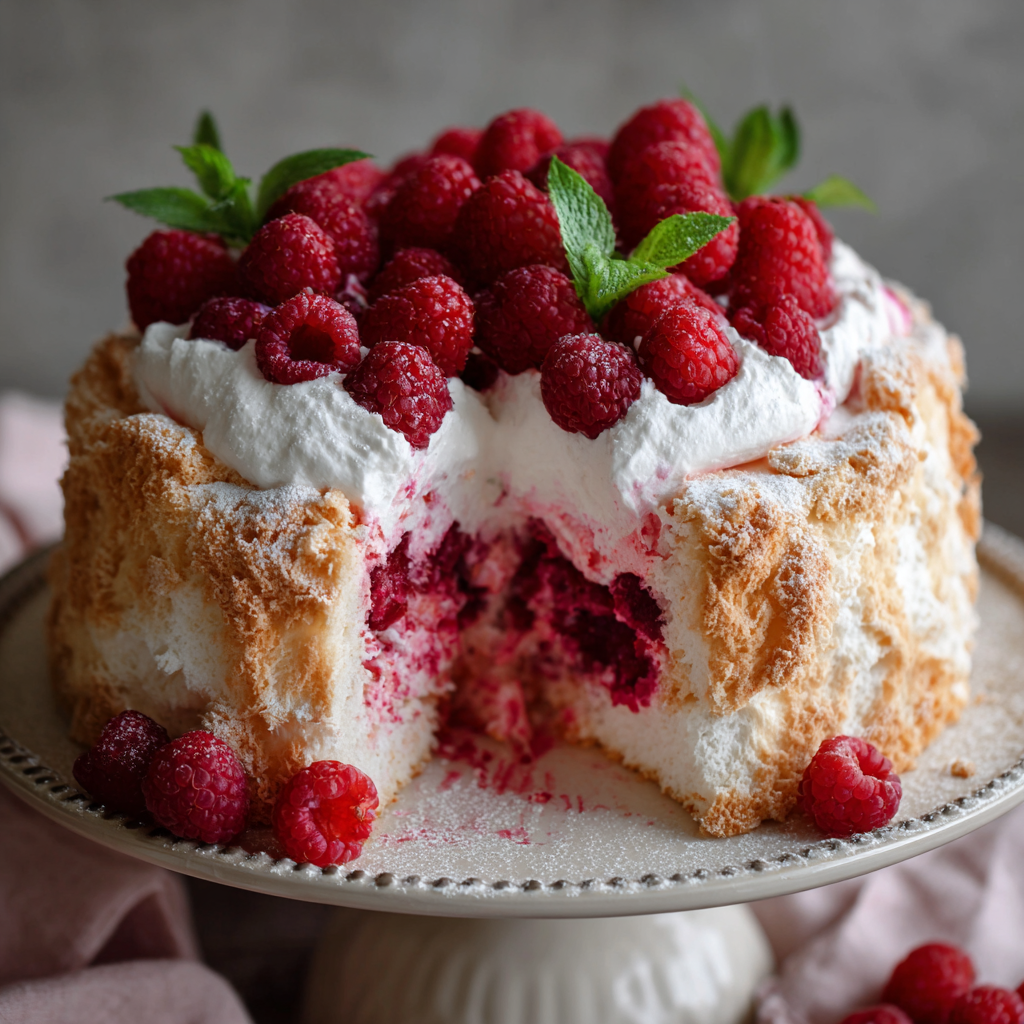
The Gastronomic Architecture of “Protein-Leavened” Sponges
In the hierarchy of pastry, Angel Food Cake represents a sophisticated study in Mechanical Leavening and Colloidal Stability. Unlike butter cakes, which rely on chemical leaveners and fat, Angel Food Cake is a fat-free foam held together by the coagulation of egg white proteins. The technical challenge is the “Structure-to-Air Ratio”: you must fold in the raspberry components without collapsing the delicate protein matrix you’ve spent ten minutes building.
Data from food science indicates that the pH of the Egg Whites is the most critical factor. By adding Cream of Tartar, you lower the pH, which denatures the proteins just enough to create a more flexible, stable foam that can support the weight of the flour and fruit.
The Essential Mise en Place: Technical Specs
To achieve a “cloud-like” crumb that doesn’t collapse, the purity of your equipment and the particle size of your dry ingredients are the most critical factors.
The Foundation (The Foam)
- Egg Whites (12 large / approx. 360ml): Technical Requirement: Must be at room temperature and 100% free of yolk. Even a microscopic drop of fat (yolk) will prevent the proteins from bonding.
- Superfine (Caster) Sugar (300g): Divided into two parts. Half is pulsed with the flour to keep it light; the other half stabilizes the meringue.
- Cream of Tartar (1 tsp): The essential stabilizer for the protein lattice.
The Raspberry Infusion
- Freeze-Dried Raspberries (20g): Expert Tip: Do not use fresh berries inside the batter; their high water content will create “steam pockets” that cause the cake to collapse. Pulverize these into a fine dust to provide flavor and a natural pink hue.
- Fresh Raspberries: Reserved for the topping/compote to provide a textural and acidic contrast.
The Masterclass: Step-by-Step Culinary Execution
Phase 1: The “Micro-Sifting” Process
Pulse the flour, freeze-dried raspberry powder, and half the sugar in a food processor. Sift this mixture three times. This “Triple-Sift” technique ensures the dry ingredients are light enough to be folded into the egg foam without the force of gravity deflating the air bubbles.
Phase 2: The Soft-Peak Transformation
Whisk the egg whites with the cream of tartar and salt until frothy. Gradually add the remaining sugar, one tablespoon at a time. Whisk until medium-soft peaks form.
Technical Requirement: Do not whisk to “stiff peaks.” Over-whisked whites become brittle and dry, making them nearly impossible to fold without breaking the air cells.
Phase 3: The “Low-Shear” Folding
Sift the flour-raspberry mixture over the egg whites in four separate additions. Use a large silicone spatula to fold with a “J-motion.” You are looking for homogeneity without deflation. The batter should remain voluminous and airy.
Phase 4: The Gravity-Defying Bake
Pour the batter into an ungreased tube pan. Technical Requirement: Do not grease the pan. The cake needs to “climb” the walls of the tube to rise. Bake at 175°C (350°F) for 35–40 minutes.
Common Technical Pitfalls to Avoid
- The “Shrinking” Cake: Angel Food Cake must be cooled upside down. If cooled upright, the delicate protein structure will collapse under its own weight before it has set.
- Rubbery Texture: Caused by over-mixing the flour. This develops gluten, which is the enemy of a tender sponge. Fold only until no white streaks remain.
- The “Grease Leak”: Ensure your bowl and whisk are wiped with lemon juice or vinegar before starting to remove any residual film of fat.
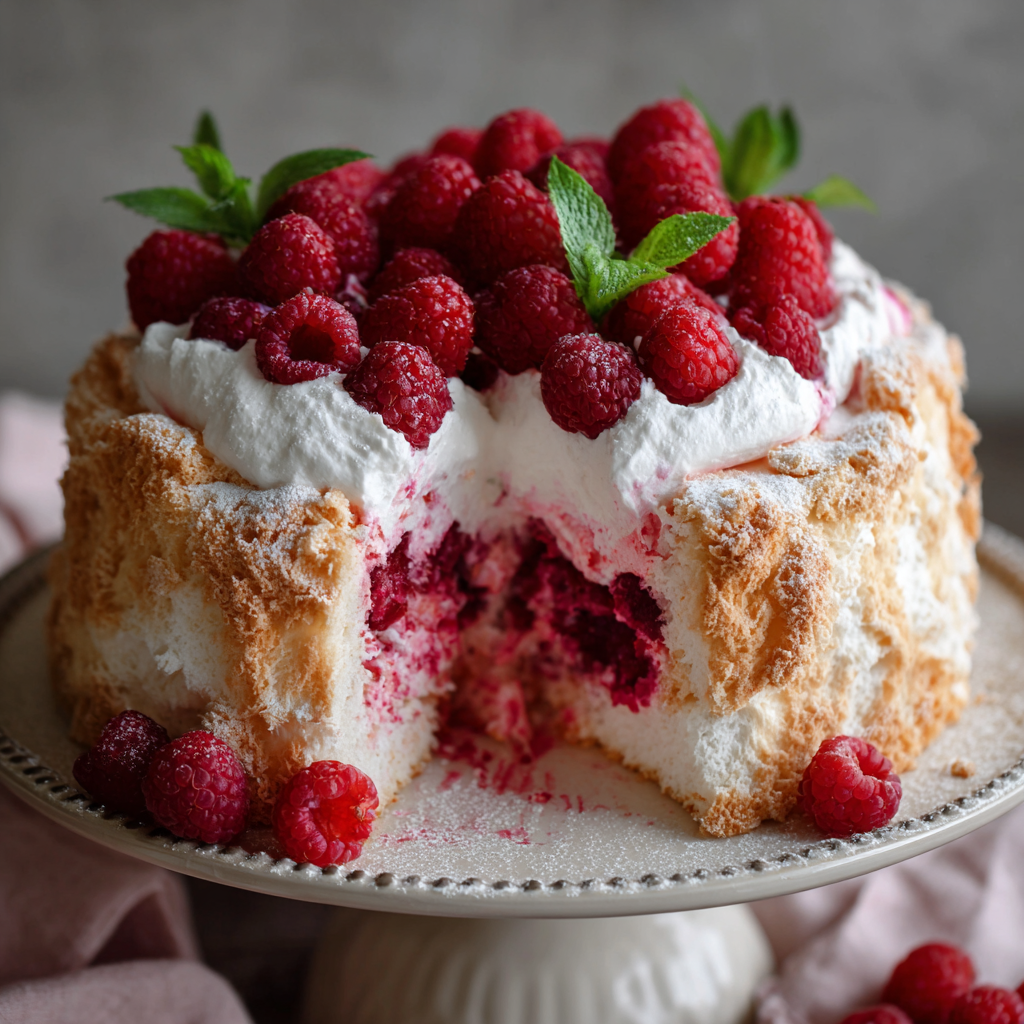
Frequently Asked Questions (Q&A)
| Question | Expert Answer |
| Can I use a regular cake pan? | No. A tube pan (Angel Food pan) is required to ensure heat reaches the center of the cake quickly, allowing it to set before the foam collapses. |
| Why freeze-dried fruit? | It provides intense flavor and color without adding moisture, which is the primary cause of “sunken” Angel Food cakes. |
| How do I cut it? | Use a serrated knife and a gentle sawing motion. A straight blade will squash the air out of the sponge. |